Home / State Leaders / Page 19

LEAP Preschool: An Inclusive Model of Early Autism Intervention

In this webinar, Phil Strain and Ted Bovey introduce you to the LEAP Preschool Model, an inclusive, evidence-based model for young children with autism that was founded in 1981. The webinar begins with an overview of key model Ted Bovey components, follows with a discussion of several key research findings from over 30 years of research on the intervention strategies used and outcomes for children in the program and then wraps up by highlighting some of the key lessons learned about preschool inclusion for young children with autism. The LEAP Model parallels the levels of the Pyramid Model in many ways and similarities between LEAP and Pyramid implementation are briefly outlined.
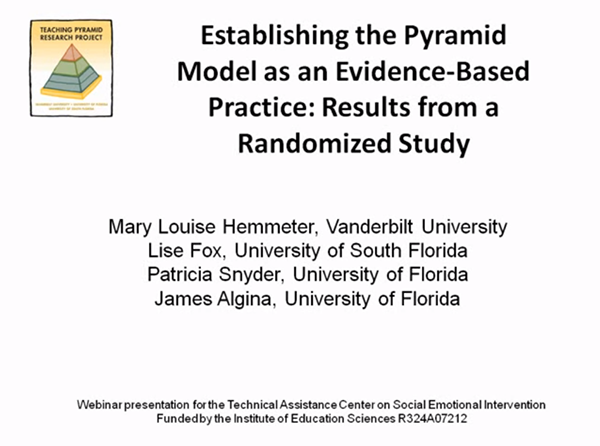
Establishing the Pyramid Model as an Evidence-Based Practice: Results from a Randomized Study

In this webinar, Mary Louise Hemmeter and Lise Fox discuss a recently completed, randomized trial that examined the implementation of the Pyramid Model within public school preschool classrooms in Tennessee and Florida that included children with disabilities. They describe the research methods, training and supports provided to teachers, and the outcomes for teachers and children including children with challenging behavior. The discussion focuses on issues related to implementation fidelity, coaching, and measuring the outcomes associated with Pyramid Model implementation.

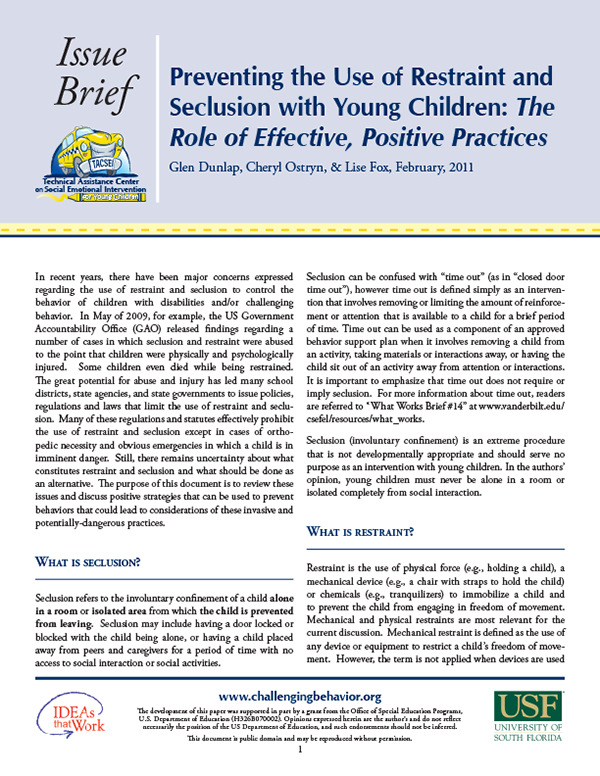
Preventing the Use of Restraint and Seclusion with Young Children: The Role of Effective, Positive Practices

In recent years, there have been major concerns expressed regarding the use of restraint and seclusion to control the behavior of children with disabilities and/or challenging behavior. In May of 2009, for example, the US Government Accountability Office (GAO) released findings regarding a number of cases in which seclusion and restraint were abused to the point that children were physically and psychologically injured. Some children even died while being restrained. The great potential for abuse and injury has led many school districts, state agencies, and state governments to issue policies, regulations and laws that limit the use of restraint and seclusion. Many of these regulations and statutes effectively prohibit the use of restraint and seclusion except in cases of orthopedic necessity and obvious emergencies in which a child is in imminent danger. Still, there remains uncertainty about what constitutes restraint and seclusion and what should be done as an alternative. The purpose of this document is to review these issues and discuss positive strategies that can be used to prevent behaviors that could lead to considerations of these invasive and potentially-dangerous practices. (February, 2011).

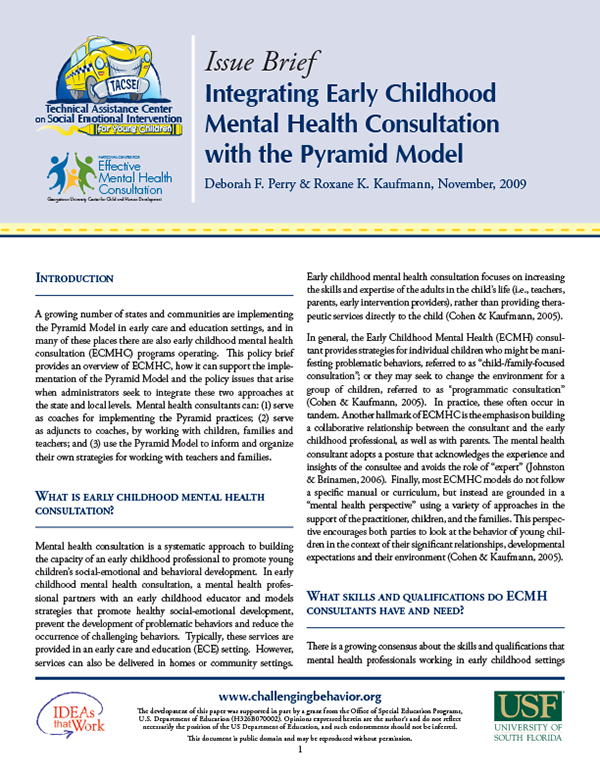
Integrating Early Childhood Mental Health Consultation with the Pyramid Model

A growing number of states and communities are implementing the Pyramid Model in early care and education settings, and in many of these places there are also early childhood mental health consultation (ECMHC) programs operating. This practice brief provides an overview of ECMHC, how it can support the implementation of the Pyramid Model and the issues that arise when administrators seek to integrate these two approaches at the state and local levels. Mental health consultants can: (1) serve as coaches for implementing the Pyramid practices; (2) serve as adjuncts to coaches, by working with children, families and teachers; and (3) use the Pyramid Model to inform and organize their own strategies for working with teachers and families. (November, 2009).