Self-Care for Teachers (Somali)
Thumbnail view of page one of the Self-Care for Teachers (Somali) resource

When children engage in behavior that pushes your buttons, it is important to be intentional in how you respond. This resource provides strategies that you might use when a child’s behavior pushes your buttons to help you respond in a way that is supportive of the child. The translation of this document was performed by … Read more
Self-Care for Teachers (Russian)

Thumbnail of page one of the Self-Care for Teachers (Russian) resource.

When children engage in behavior that pushes your buttons, it is important to be intentional in how you respond. This resource provides strategies that you might use when a child’s behavior pushes your buttons to help you respond in a way that is supportive of the child. The translation of this document was performed by … Read more
Self-Care for Teachers (Hmong)

Thumbnail image of the Self-Care for Teachers (Hmong) resource.

When children engage in behavior that pushes your buttons, it is important to be intentional in how you respond. This resource provides strategies that you might use when a child’s behavior pushes your buttons to help you respond in a way that is supportive of the child. The translation of this document was performed by … Read more
Self-Care for Teachers (Arabic)

Thumbnail of page one of the Self-Care for Teachers (Arabic) provided by the Oregon State University Implementation Support Team

When children engage in behavior that pushes your buttons, it is important to be intentional in how you respond. This resource provides strategies that you might use when a child’s behavior pushes your buttons to help you respond in a way that is supportive of the child. The translation of this document was performed by … Read more
Self-Care for Teachers (Spanish)

Thumbnail view of page one of Self-Care for Teachers (Spanish) translation provided by the Oregon State University Implementation Support Team

When children engage in behavior that pushes your buttons, it is important to be intentional in how you respond. This resource provides strategies that you might use when a child’s behavior pushes your buttons to help you respond in a way that is supportive of the child. The translation of this document was performed by … Read more
Pyramid Model Practices for Family Child Care Homes (Russian)

Thumbnail view of page one of the Pyramid Model Practices for Child Care Homes (Russian)

This resource provides family child care home providers with best practices that can be used to support children at each tier of the Pyramid Model. The translation of this document was performed by a third party. NCPMI makes no guarantees as to the accuracy of the translation.

Behavior Incident Report Form (Spanish)

Thumbnail view of the first page of the Behavior Incident Report (Spanish) translated by the team at Oregon State University Implementation Support Team

This tool is designed to track and assist in measuring disciplinary actions across demographics of children. The translation of this document was performed by a third party. NCPMI makes no guarantees as the accuracy of the translation.

Staff Buy-In Presentation for BIR (Spanish)

Thumbnail of one of the BIR Staff Buy-In Presentation slides, Spanish version provided by the OSU Inclusion Implementation Support Team

This presentation introduces the BIR to programs/teachers and explains how and why we collect data and make it meaningful. The translation of this document was performed by a third party. NCPMI makes no guarantees as to the accuracy of the translation.

Behavior Incident Report (BIR) Instructions (Spanish)

Thumbnail view of page 1 of the Spanish translation of the Behavior Incident Report provided by the OSU Inclusion Implementation Support Team

The BIR Instructions document includes a link for BIR training, definitions, and guidance on when and how to complete a BIR. This form translates the English version of the instructions in the BIRS package. The translation of this document was performed by a third party. NCPMI makes no guarantees as to the accuracy of the … Read more

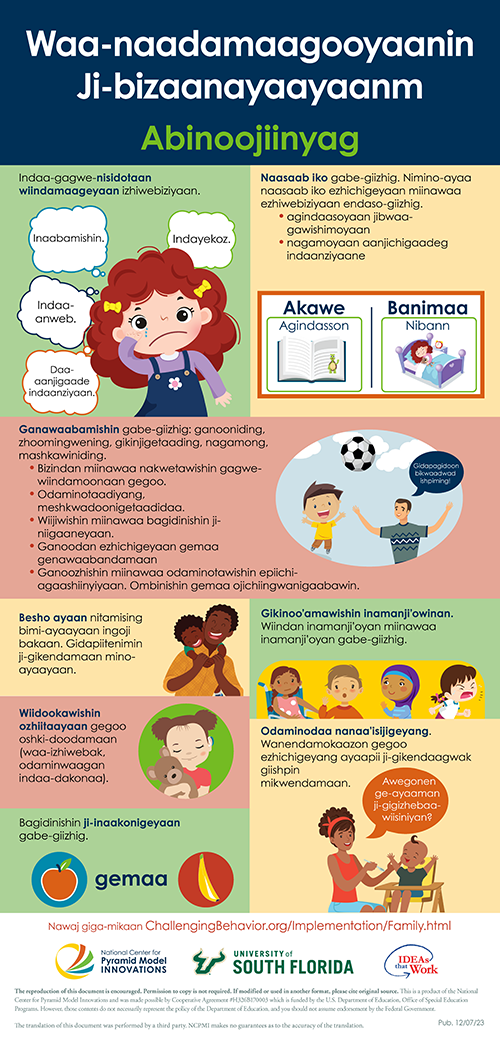
Things That Will Help Me Stay Calm – Toddlers (Ojibwe, PDF)

Thumbnail image of the Ojibwe version of the Help Me Stay Calm - Toddlers Infographic

Toddlers experience big emotions as they learn to make meaning of their world and communicate their needs. Toddlers look to their primary caregivers to let them what they are experiencing is okay. Caregivers can use the strategies included in this infographic to provide toddlers with predictability in their day, safety in relationships, meaning to their … Read more