What to Expect from the Prevent-Teach-Reinforce for Families Process
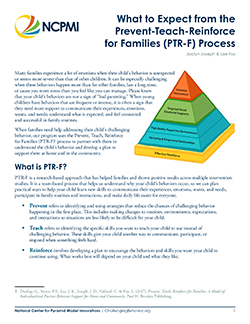
This handout can be provided to families to understand what will happen in the Prevent-Teach-Reinforce for Families process.
This handout can be provided to families to understand what will happen in the Prevent-Teach-Reinforce for Families process.
This family handout provides guidance to families on how to navigate conversations when receiving news about their child’s behavior. Families can use this resource to get ideas and tips for collaborating with their child’s program and teachers, including specific questions to ask and prompts getting collaborative conversations started.
This resource outlines guidance for identifying, preparing, and supporting practitioners responsible for facilitating the development and implementation of individualized positive behavior support (IPBS) plans in early childhood Pyramid Model settings.
Supporting Behavior Through Connection is a practical resource for families and early childhood practitioners that shifts the focus from compliance to connection. It offers simple, relationship-centered strategies to respond to challenging behavior in ways that help children feel safe, valued, and supported. The resource describes three practices, including examples and prompts, that can be used … Read more

This guide provides Pyramid Model leadership teams and practitioners with guidance on developing and implementing Tier 2 within the Pyramid Model.

This workbook, part reflection guide and part practice resource, supports practitioner coaches, program implementation coaches, infant and early childhood mental health consultants, and early childhood practitioners in having meaningful conversations about approaching children’s behaviors with connection and care.

This resource collection offers information and materials for states, communities, and early childhood programs seeking further information on Infant and Early Childhood Mental Health Consultation (IECMHC) and the integration with the Pyramid Model. Created: 7/15/2025
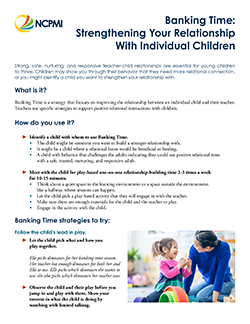
Banking Time is a strategy that focuses on improving the relationship between an individual child and their teacher. Learn the strategies to implement the intervention and use the reflective companion to support your implementation.

Teaching Tools for Young Children (TTYC) offers a straightforward resource for practitioners and coaches to support children who struggle with challenging behavior in routines and activities. TTYC suggests specific step-by-step strategies for practitioners to consider when they know the function (or purpose) of a child’s challenging behavior.
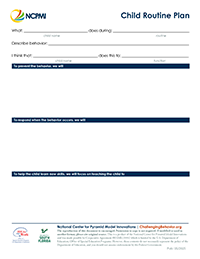
Teaching Tools for Young Children form for listing the strategies for supporting a child with challenging behavior within a classroom routine.



This website was made possible by Cooperative Agreement #H326B220002 which is funded by the U.S. Department of Education, Office of Special Education Programs. However, those contents do not necessarily represent the policy of the Department of Education, and you should not assume endorsement by the Federal Government. This website is maintained by the University of South Florida. Contact webmaster.