Routine Analysis Form

Used to identify a routine where the child is most likely to have challenging behavior.
Used to identify a routine where the child is most likely to have challenging behavior.

This resource offers guidance on supporting children after stressful events and includes strategies for families and caregivers to create safety and predictability through routines, clear communication, and emotional connection.
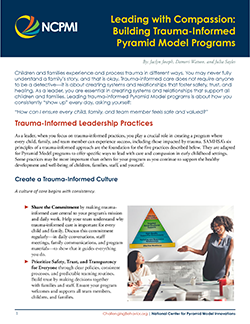
Leadership practices for creating systems and relationships that support staff, families, and children.
Dominic Paz (Oregon) and Alli Lowe-Fotos (Illinois), discuss the development of statewide systems, resources, and training efforts to combat the use of exclusionary discipline in early childhood education programs. In this discussion, the panelists talk about the importance of policy, training, and technical assistance for implementing the Pyramid Model, trauma-informed care, Infant and Early Childhood … Read more
Join our panelists, Dominic Paz (Oregon) and Alli Lowe-Fotos (Illinois), for a discussion about the development of statewide systems, resources, and training efforts to combat the use of exclusionary discipline in early childhood education programs. In our discussion, the panelists will talk about the importance of policy, training, and technical assistance for implementing the Pyramid Model, trauma-informed … Read more

As a coach have you ever observed a teacher or early interventionist that seems down or is disengaged with children or families? Have you ever worried about the level of a provider’s stress? Have you been unsure what to say or how to help? Research has demonstrated a link between early childhood teachers’ poor health … Read more

This practice brief provides prevention strategies to help children with challenging behavior who have been exposed to trauma and strategies for responding to children when they are trauma-activated.
As a coach have you ever observed a teacher or early interventionist that seems down or is disengaged with children or families? Have you ever worried about the level of a provider’s stress? Have you been unsure what to say or how to help? Research has demonstrated a link between early childhood teachers’ poor health … Read more
This resource provides tips and examples of reflective questions early providers can ask caregivers to gain more specific information on social and emotional outcomes, co-regulation, and challenging behavior.
This guide provides cross-sector teams at the state, territory, tribal, and local levels with strategies for collecting and using data to understand exclusionary discipline across the mixed delivery system of early care and education programs.



This website was made possible by Cooperative Agreement #H326B220002 which is funded by the U.S. Department of Education, Office of Special Education Programs. However, those contents do not necessarily represent the policy of the Department of Education, and you should not assume endorsement by the Federal Government. This website is maintained by the University of South Florida. Contact webmaster.