Early Interventionist Practitioner Coach Guide
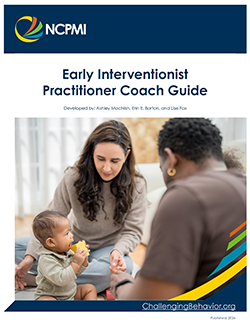
This manual provides a valuable resource full of tips and guidance for practitioners implementing coaching with early interventionists.
This manual provides a valuable resource full of tips and guidance for practitioners implementing coaching with early interventionists.
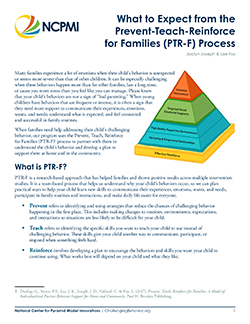
This handout can be provided to families to understand what will happen in the Prevent-Teach-Reinforce for Families process.
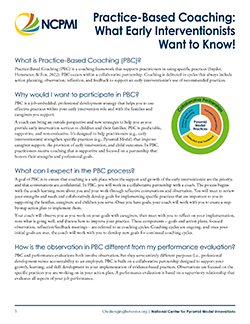
Handout to provide to early interventionist to explain what to expect from practice-based coaching.

This resource provides a strategic framework for program leadership teams to integrate Practice-Based Coaching (PBC) into professional development plans, supporting the implementation of the Pyramid Model. It outlines various coaching formats and offers guidance on selecting delivery methods based on practitioner needs and available program resources. Additionally, teams can utilize the Map It Out template to assist their … Read more
Part guide and part planning tool, this resource, created in collaboration with the TIES Center, helps early childhood teams and families partner to build more inclusive programs and environments where every family feels a sense of belonging. Centered on the experiences of families, it outlines ten dimensions of belonging, offers prompts for shared reflection, and … Read more

This resource collection offers information and materials for states, communities, and early childhood programs seeking further information on Infant and Early Childhood Mental Health Consultation (IECMHC) and the integration with the Pyramid Model. Created: 7/15/2025

This resource offers guidance on supporting children after stressful events and includes strategies for families and caregivers to create safety and predictability through routines, clear communication, and emotional connection.
Leadership practices for creating systems and relationships that support staff, families, and children.

This practice brief provides prevention strategies to help children with challenging behavior who have been exposed to trauma and strategies for responding to children when they are trauma-activated.



This website was made possible by Cooperative Agreement #H326B220002 which is funded by the U.S. Department of Education, Office of Special Education Programs. However, those contents do not necessarily represent the policy of the Department of Education, and you should not assume endorsement by the Federal Government. This website is maintained by the University of South Florida. Contact webmaster.